Shopping cart is empty.
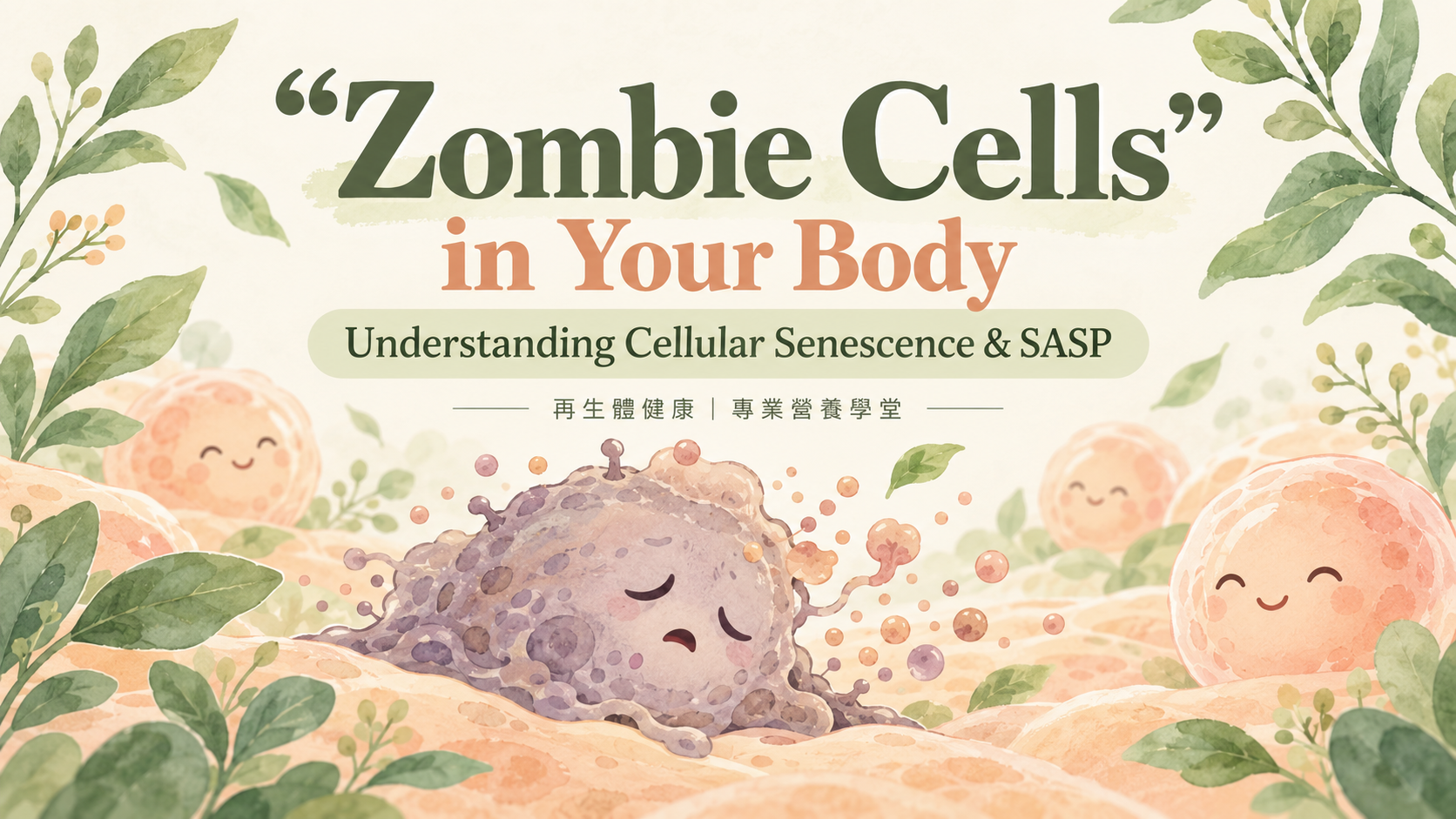
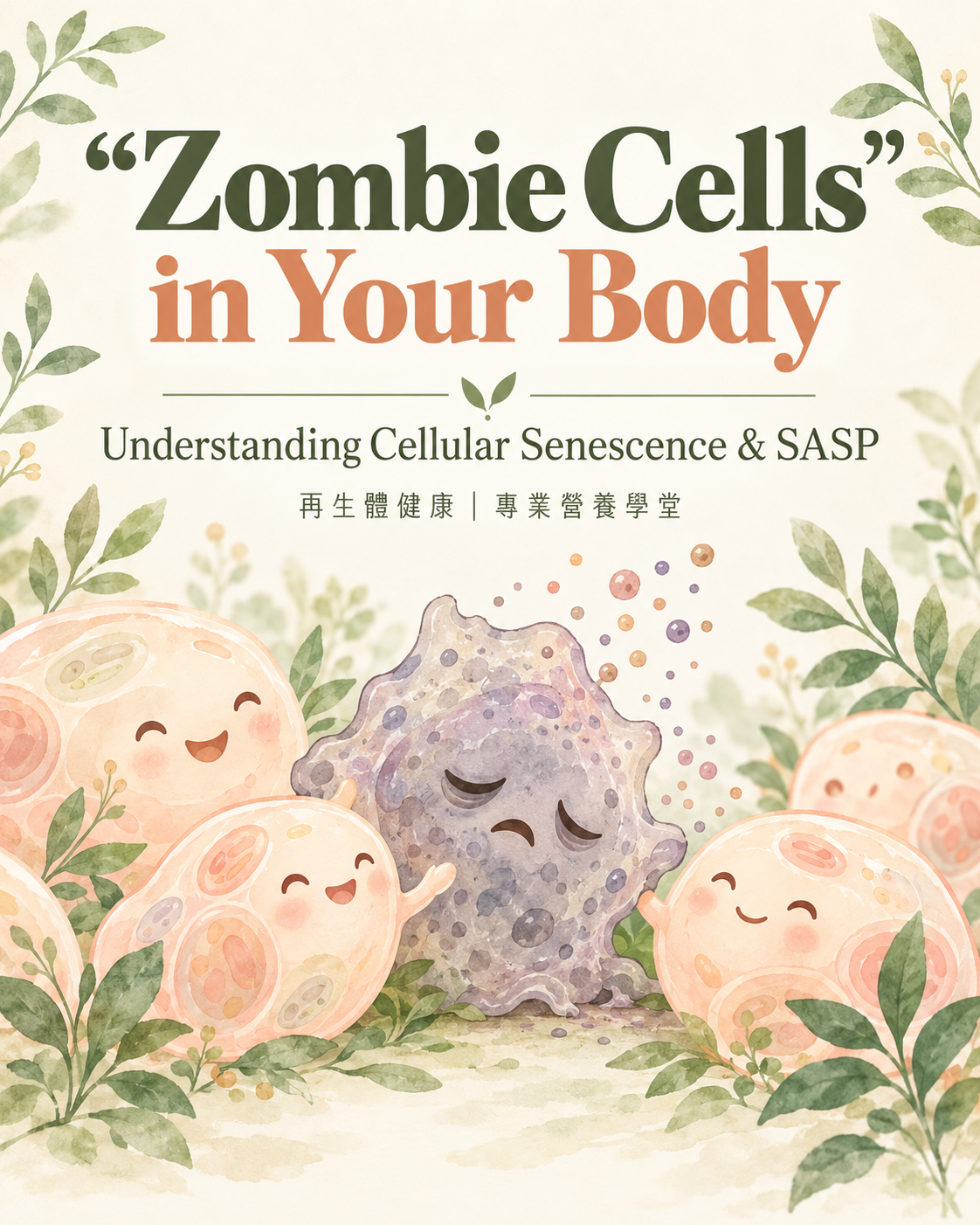
“Zombie Cells” in Your Body: Understanding Cellular Senescence and SASP
再生體健康|專業營養學堂
Summary: “Zombie cells” is a popular nickname for senescent cells. Understanding what these cells do—and what research on diet and exercise can actually tell us—helps turn healthy aging into practical daily choices.
When we think about aging, skin care may come to mind first. Yet changes also take place inside the body, at the level of individual cells. One topic attracting attention is the so-called “zombie cell.” The name is a metaphor, not a diagnosis: feeling tired or noticing wrinkles does not tell you how many senescent cells you have.
No longer dividing, but still active
The scientific term is senescent cells. Certain forms of stress or damage can cause cells to enter a stable state in which they stop dividing. This process is called cellular senescence. These cells remain alive and metabolically active; describing them as “half-dead” is misleading.[1]
Think of a colleague who has stopped taking on new assignments but still sends messages around the office. The analogy helps explain why a cell can affect its surroundings without dividing. Its actual effects depend on the cell type, tissue and biological context.
SASP is not a single “aging toxin”
Some senescent cells release a mixture of signaling molecules and proteins, including factors involved in inflammation. This pattern is called the senescence-associated secretory phenotype, or SASP.[2]
These signals can change the environment around a cell. Under some conditions, they promote inflammation or contribute to senescence-related changes in neighboring cells. This is not an infection spreading from cell to cell, and calling the entire mixture a toxin oversimplifies the biology.[2]
Senescence also has useful roles
Stopping cell division can help prevent damaged cells from continuing to multiply. Senescent cells also participate in normal wound repair. Concerns arise when certain senescent cells persist and accumulate, with effects that vary across tissues and conditions.[1]
Scientists are investigating links between cellular senescence and age-related diseases. These links do not mean that having senescent cells guarantees dementia or cancer. Fatigue, skin changes and slow wound healing also have many possible causes. Persistent or troublesome symptoms deserve medical assessment rather than a self-diagnosis of “too much SASP.”
Can plant compounds remove “zombie cells”?
Plant compounds such as quercetin and fisetin are being studied in this field. Fisetin research, for example, has reported findings in cell experiments, mice and human tissue studied outside the body. Such findings provide a basis for further investigation.[3]
Experimental concentrations and dosing are not equivalent to eating an ordinary serving of fruit or vegetables. The findings do not establish that onions, berries or green tea clear senescent cells in people. Nor do they justify treating everyday foods or supplements as proven senolytic therapies.[1,3]
For everyday meals, a practical approach is variety: rotate vegetables and fruits of different colors, and include whole grains, legumes and appropriate protein sources. An overall balanced eating pattern is a more useful goal than searching for a single “anti-aging” ingredient.
Make healthy aging part of daily life
Regular physical activity has established health benefits. For most adults, World Health Organization guidance recommends 150–300 minutes of moderate-intensity aerobic activity each week, or an equivalent amount of vigorous activity, plus muscle-strengthening activities on at least two days.[4]
Start with an activity that suits your abilities, such as walking, cycling or simple resistance exercises, and build up gradually. If you have a chronic condition or limited mobility, discuss suitable options with a healthcare professional. These recommendations support overall health; they are not a guarantee that exercising a certain number of times will activate autophagy and eliminate senescent cells.
Skin care and overall health can be cared for together. Learning about cellular senescence is an opportunity to understand the body more clearly and make thoughtful, realistic choices.
Follow 再生體健康 for more accessible, evidence-informed health knowledge—and practical ways to bring it into everyday life.
This article provides general health education and is not intended for personal diagnosis or treatment.